
The Mohawk Turn

My 14-year-old son has never taken my advice when it comes to playing hockey. And why should he? I’ve never played, I get confused when someone refers to the “the offensive zone” – that’s the side with our goal, not their’s, right? --and the way I know when a goal is scored is that everyone on the scoring team raises their sticks in the air. But I’ve watched enough youth hockey games over the last seven years to have some understanding of the sport, enough to know my son needs to learn how to do a Mohawk Turn.
If you don’t know what a Mohawk is, turn on any NHL game, and you’ll see players doing it constantly. It’s when they put the heels of their skates together, like first position in ballet, but the knees are usually bent, like they’re doing a plie’. It’s a turn most coaches teach players to put in their arsenal of skating moves, and if done correctly, a player could move around the circumference of a circle, though they usually only skate about a quarter of it before skating off in one direction or the other. In fact that’s the point of a Mohawk: it enables a player to transition quickly from one direction to another. And yet every time I tell my son he needs to learn it, he refuses.
“I don’t need it,” he says.
It’s astounding that of the 578,000 young men playing youth hockey today, I live with the one player who doesn’t need this skill.
It is this intransigence that has made getting along with my son so very difficult. Take this morning. He just started high school and has been waking up at 5.45 a.m. to catch a 6.45 a.m. bus to school half an hour away, but the bus hasn’t been showing up until 7.00 a.m., so I let him sleep in a bit. But he didn’t get the concept that if you wake up a bit later, you’ve got to move a little faster – not slower, which seemed to be what he was doing.
“You’re going to miss your bus, and I’m not driving you,” I called up the stairs.
I called him several more times to come down before I stomped up the steps to find him pulling pins out of a new button-down shirt, 1, 2, 3, 4 pins.
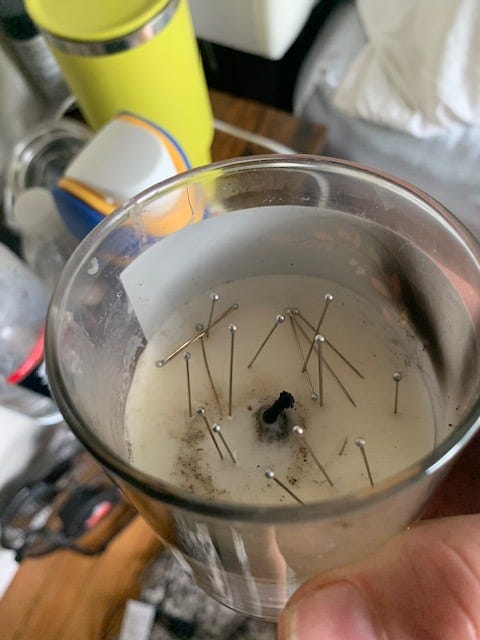
“How many pins are in the shirt?” he asked.
“Eight, I think? But c’mon. You have to go!”
He came downstairs, quickly ate his breakfast and was about to walk out the door when he pivoted. “One sec,” he said and ran back up the stairs. “Where’s my sweater?!”
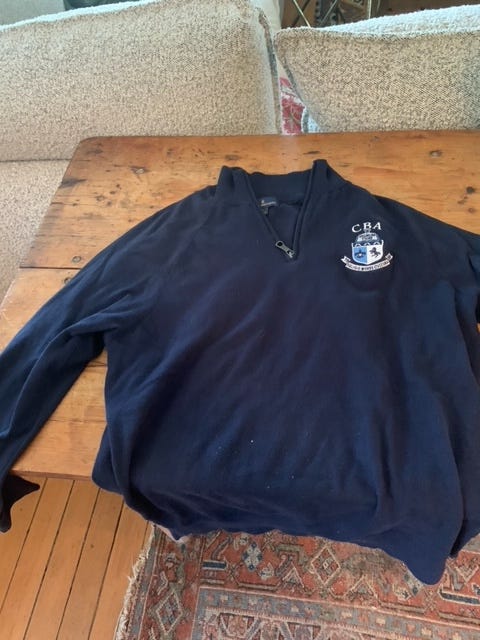
He attends a boy’s Catholic school and as such, has a school uniform: khakis, belt, button-down shirt, tie, and either a blazer or a designated sweater, which has the school’s insignia sewn on.
“Your sweater is dirty. Wear the blazer,” I said.
“Where is it?” he yells down the stairs. “Found it!”
He came bounding down the stairs with the blazer in his hands.
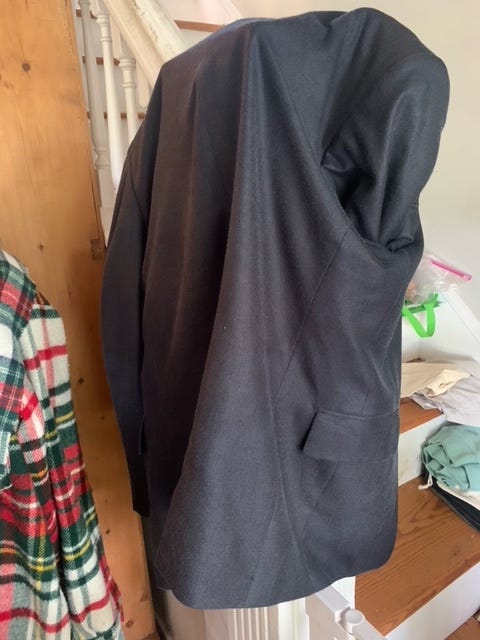
“I’ll drive you to the bus stop,” I said and followed him out the door.
“You know I don’t even have to wear this,” he said, holding the blazer like an unwanted friend trying to tag along. He got in the car.
“Yes, you do. It’s part of the uniform,” I said.
“No, I don’t,” he snapped, with a snarl reserved for his most reviled enemies and his mother. “There are kids who don’t wear it, and nothing happens to them.”
He seemed to have access to the disciplinary files of every student in the school.
“Maybe you don’t know what happens to them. Maybe they’ve been warned they’re going to get kicked out of the school,” I said.
I seemed to have my own access to these files.
“You don’t need the blazer or the sweater!” he said.
As we approached the bus stop, there was one boy there wearing airpods and reading his phone. His brother had been at the school for three years and was now a senior. I pulled up right next to him, parking on the wrong side of the road to do it, and rolled down my window.
“Can you hear me?” I asked.
“Yes,” he said.
“Do you have to wear a blazer or sweater to school?” I asked, looking at the sweater he was wearing with the school insignia.
“You absolutely do not have to,” he said. He sounded definitive.
Shoot, I thought, but I persisted. “And you know this how? Because you were told by people at school or because your brother has gone there for years?”
“Both,” he said.
I looked over at my son. He had a huge smile on his face. Without the benefit of having a school official there to weigh in, it was two against one, which made me believe he was right. And not only was he right, but his mother had parked on the wrong side of the road facing the oncoming traffic, in search of vindication, only to be told she was incorrect.
By the time I got home, I felt like a heel. When I was a kid, my mother seemed to question things I told her, but if a friend said it, it was gospel. I used to think that in the classic scenario where a neighbor comes banging on the door to say their child had been wronged, the parent opening the door will stand up for their child – even if they scold the child later, after the neighbor is gone. It’s this innate defensiveness for their own. In my case, my mother would take the neighbor’s side and scold me right then and there, even if I was in the right. I decided to send my son a text, in the middle of his school day. He’d probably long since forgotten the incident, but I reminded him.
“Hey, it’s not that when you say something, I don’t believe it, and then when one of your friends says something, I believe it. It’s that Joey has a brother who’s gone to that school for years. And also…” (you know your text is too long when you say, ‘And also’) “…hearing Joey confirm what you said meant two people were now saying the same thing.”
When it comes to my son, if I find myself in the wrong, I can be too contrite, particularly if in the course of our disagreement, I yelled — which is almost always the case and it certainly was that day. I get too apologetic. But as a parent, it’s a delicate balance, acknowledging you were wrong, while not undermining your institutional knowledge and authority. It’s like you’re on a path with your child, dispensing knowledge, and now and again when you’re wrong, you have to make a quick detour before returning to that path of knowledge. Which brings me back to the Mohawk turn. A Mohawk enables a player to pivot while maintaining their momentum. In parenting, you need to pivot as well, but you have to maintain the momentum that you may have been wrong this time, but most of the time, you’re right.

Good one!